
Independent pharmacies in the UK are under pressure from every direction: tighter margins on core dispensing, growing demand for private services, and patient expectations shaped by modern digital experiences. In that environment, your website is no longer a passive brochure. It is your most important patient conversion asset.
Yet most pharmacy websites still underperform. They bury key services, make booking hard on mobile, and fail to communicate trust signals quickly enough. Patients land on the page, cannot find what they need in seconds, and leave for a competitor. That loss is not just traffic. It is missed flu jab bookings, missed travel vaccine appointments, missed Pharmacy First consultations, and missed long-term patient relationships.
The opportunity is significant. Pharmacy First expansion and private service growth are creating a stronger digital demand curve for local pharmacies that can communicate clearly and convert efficiently.
This guide explains exactly what high-performing pharmacy website design UK projects include in 2026: the right page architecture, compliance requirements, SEO foundations, conversion-focused booking flows, realistic costs, and a practical launch plan.
Why your pharmacy website matters more than ever
1. Pharmacy First is changing patient demand patterns
Pharmacy First has accelerated local search behavior. More patients now search online before deciding where to access care for minor conditions. If your website is unclear about consultation eligibility, service scope, opening hours, or booking options, those patients choose someone else.
Your site should make Pharmacy First pathways obvious from the homepage and service pages, not hidden behind generic menus.
2. Private services create margin opportunities
Independent pharmacies can improve profitability through private services, including travel vaccinations, flu jabs, weight management support, ear care, and health checks. But margin opportunities only convert when service discovery is easy and trust is immediate.
A high-performing website for pharmacy growth should do three things clearly:
- Explain each private service in plain language.
- Reduce booking friction on mobile.
- Reinforce trust with credentials, reviews, and process clarity.
3. Most patient journeys start on Google
A typical search journey looks like this:
pharmacy near me flu jabtravel vaccinations [borough]pharmacy first consultation [location]
If your local SEO, service page content, and map signals are weak, your pharmacy loses visibility before the patient even visits your site.
4. Mobile experience directly affects conversion
For many pharmacies, most traffic is mobile. Patients often search while commuting, at work, or while managing urgent family needs. If forms are long, CTAs are unclear, or pages load slowly, users drop off quickly.
When booking is hard, patients do not wait. They choose the next result.
Core pages every pharmacy website needs
A successful pharmacy website is built around conversion architecture, not just visual design. You need clear page intent, strong internal linking, and service-first navigation.
Homepage: your conversion command center
Your homepage should answer five questions in under 10 seconds:
- Which pharmacy is this and where are you located?
- Do you provide NHS and private services?
- What can I book right now?
- Why should I trust you?
- How do I contact you quickly?
Recommended homepage sections:
- Hero headline with locality:
Independent pharmacy in [location] - NHS + private services. - Service overview cards for prescriptions, Pharmacy First, and private services.
- Trust block with GPhC registration signal, review proof, and opening hours.
- Fast-action CTAs: book appointment, request prescription, call now, WhatsApp.
- Map and accessibility notes for quick visit decisions.
The homepage should route users to dedicated service pages, not force them to search internally.
Service pages: one page per high-intent service
Most pharmacies underperform because they place multiple services on one generic page. In 2026, each high-value service needs its own intent-focused page.
Essential service pages include:
- Pharmacy First consultations.
- Travel vaccinations.
- Flu jabs and seasonal vaccines.
- Prescription collection and delivery.
- Minor ailments services (for example, ear wax support, UTI pathways, common infection advice where applicable).
Each service page should follow a conversion structure:
- Pain point: why patients search this service.
- Solution: what your pharmacy provides.
- Eligibility and process: who can book and what happens next.
- Pricing guidance where appropriate.
- Booking CTA with clear next step.
- FAQ section with schema-ready answers.
For local intent, include borough-specific phrasing naturally, for example:
flu jab [borough name]travel vaccines in [location]
Do not keyword stuff. Keep language patient-friendly and specific.
About page: trust and clinical confidence
Your about page is not optional brand fluff. It is a decision page.
Include:
- Pharmacist and team credentials.
- GPhC registration context.
- Clinical specialisations and service focus areas.
- Real team photography to reduce perceived risk.
- Community involvement and local credibility.
Patients are more likely to book when they see who is behind care delivery.
Contact and location page: reduce decision friction
Your contact page should support immediate action.
Include:
- Embedded Google Map.
- Opening hours plus holiday hour updates.
- Click-to-call button.
- WhatsApp quick-contact option.
- Booking and prescription links.
- Transport/parking guidance if relevant.
Treat this page as a conversion asset. Many users will land here directly from local search.
Blog and education pages: support SEO and trust
A pharmacy content hub supports both search visibility and patient confidence.
High-impact topics include:
What is Pharmacy First?How much does a travel vaccine cost in the UK?When should I book my flu jab?
Educational pages should always link to corresponding service pages and booking actions.
Compliance and security requirements for UK pharmacy websites
Pharmacy websites operate in a trust-sensitive and regulated context. Design and development decisions must reflect this from day one.
GPhC-aligned service communication
Service pages should be accurate, clear, and non-misleading. Avoid exaggerated claims and vague treatment promises. Patients should understand exactly what is available, where, and under which conditions.
Practical rule: write for patient clarity first, then optimize for SEO.
GDPR and patient data handling
If your website captures personal data via forms, booking flows, or contact requests, GDPR responsibilities apply.
Key requirements:
- Clear consent language on forms.
- Transparent data usage explanation.
- Privacy policy linked from every form touchpoint.
- Data minimisation in form fields.
- Secure submission handling and storage.
For baseline obligations, align with UK GDPR guidance.
Accessibility (WCAG AA baseline)
Pharmacy websites serve broad patient demographics, including users with visual, motor, and cognitive accessibility needs.
At minimum, build to WCAG AA patterns:
- Sufficient color contrast.
- Keyboard navigable menus and forms.
- Accessible labels and error handling.
- Semantic heading structure.
- Screen reader friendly controls.
Reference standard requirements at WCAG guidelines.
Accessibility is both ethical and commercial. Better accessibility generally improves usability for all patients.
HTTPS and secure infrastructure
For booking and prescription-related interactions, HTTPS is non-negotiable.
Security essentials:
- Valid SSL certificate.
- Secure hosting configuration.
- Routine patching and dependency updates.
- Spam and abuse protection for forms.
- Backups and recovery planning.
Security failures damage trust quickly and can directly reduce booking volume.
Privacy policy and cookie consent
A compliant website should clearly expose:
- Privacy policy.
- Cookie policy.
- Cookie preferences mechanism where required.
- Contact details for data queries.
Do not hide legal pages in inaccessible footer patterns. Users and auditors must find them easily.
Pharmacy website SEO strategy (2026)
A high-performing pharmacy SEO UK strategy combines local visibility, service-intent content, and technical consistency.
Local SEO (priority #1)
For independent pharmacies, local SEO usually creates the fastest return.
Google Business Profile optimisation
Your profile should be fully operational, not passive.
Focus areas:
- Correct primary and secondary categories.
- Service detail completion.
- Fresh photos and posts.
- Consistent opening hours.
- Active review acquisition and response process.
NAP consistency across directories
Your Name, Address, and Phone should match exactly across:
- Website contact page.
- Google profile.
- Local and healthcare directories.
- Citation platforms.
Inconsistent NAP signals dilute local trust and can weaken map visibility.
Location landing pages where relevant
If you serve multiple boroughs, location-intent pages can improve discoverability, for example:
Travel vaccinations in [borough]Flu jab clinic [borough]
Every location page must include unique value, local context, and a clear booking pathway.
LocalBusiness schema implementation
Structured data helps search engines interpret your business context.
At minimum, include LocalBusiness schema with:
- Name.
- Address.
- Phone.
- Opening hours.
- Service context.
Add Service and FAQ schema on relevant pages for richer search interpretation.
Service page SEO
Service pages are your commercial ranking engine.
Keyword intent targets
Prioritize terms like:
flu jab [location]travel vaccinations near mePharmacy First consultation [location]
Each page should target one core service intent and related variants.
Content depth and clarity
Aim for 500+ words per service page, written for patient understanding.
Cover:
- What the service is.
- Who it is for.
- How to book.
- Typical timing/process.
- Expected next steps.
FAQ sections with schema
FAQs improve both usability and search depth.
Examples:
Do I need to book in advance?How long does the appointment take?Who is eligible?
Implement FAQ schema where appropriate and keep answers medically responsible and clear.
Internal linking system
Build a strong link architecture:
- Homepage -> service pages.
- Service pages -> related blog guides.
- Blog guides -> service booking pages.
This helps both crawlability and conversion flow.
Content marketing for pharmacy growth
Most pharmacy blogs fail because they publish generic content with no service connection.
Better approach:
- Publish practical patient questions tied to real services.
- Link every guide to relevant booking pages.
- Refresh seasonal content ahead of demand peaks.
Examples:
How much does a travel vaccine cost UK?What is Pharmacy First and when should I use it?Flu jab eligibility and timing guide
Video can strengthen trust and engagement, for example a short pharmacist explainer for flu jab process or travel consultation expectations.
Patient testimonials also support trust. Where used, ensure authenticity and compliant handling.
Technical SEO foundation
Technical execution determines whether content potential becomes ranking reality.
Key requirements:
- Mobile-first design and testing.
- Core Web Vitals targets: LCP under 2.5s, CLS under 0.1.
- Optimized images using modern formats and responsive sizing.
- Crawlable architecture and clean internal navigation.
- XML sitemap and properly configured robots.txt.
For performance benchmarking and implementation standards, use Google Core Web Vitals guidance.
Measurement framework for pharmacy SEO
Track outcomes that connect to business value:
- Rankings for service + location terms.
- Organic clicks to service pages.
- Booking form submissions from organic sessions.
- Click-to-call events.
- Google Maps actions.
- Repeat prescription interactions.
Traffic alone is not enough. Focus on qualified patient actions.
For deeper service growth planning, combine this guide with SEO for Pharmacy service and our detailed SEO for Pharmacy guide.
Booking and prescription flows that convert
Conversion design in pharmacy websites is mostly about reducing cognitive effort and uncertainty.
Online booking integration options
Depending on workflow, pharmacies can use:
- Platform integrations (for example, Pharmadoctor, HealthHero, or equivalent operational tools).
- Structured custom booking forms.
- Hybrid flows that route patients based on service type.
The best implementation is the one your team can manage reliably at scale.
Prescription refill pathways
Prescription actions should be obvious and simple.
Useful flow pattern:
- Clear refill CTA in top navigation and homepage.
- Short form with minimal friction.
- Optional upload support where workflow allows.
- Confirmation and expected timeline message.
If refill UX is unclear, patients often default to phone channels and create avoidable staff overhead.
WhatsApp and rapid communication
Many patients prefer messaging for quick clarification before booking. A well-placed WhatsApp action can improve confidence and reduce drop-off, particularly for first-time private service users.
Abandoned booking recovery
If patients begin booking but do not complete, recovery automations can reclaim demand:
- Reminder email or SMS.
- Follow-up prompts for incomplete forms.
- Clear re-entry links to complete action.
Keep communication compliant and consent-aware.
Mobile-first form UX
To improve completion rates:
- Use single-column form layouts.
- Keep fields minimal.
- Use large tap targets and clear labels.
- Show progress cues for longer workflows.
- Provide instant validation and friendly error states.
These improvements can materially increase booking conversion without additional ad spend.
Real pharmacy website examples (UK)
Real implementation examples help translate strategy into execution. Below are two pharmacy website projects from our work, with practical outcomes and build patterns that independent pharmacies can apply.
Case study 1: Garner Chemist
Project reference: Garner Chemist
Challenge
Garner Chemist needed stronger digital visibility and a more efficient pathway for service discovery and appointment actions. Service demand was broad, but the online journey did not clearly guide users from search intent to booking outcomes.
Solution
We delivered a Next.js website focused on healthcare service clarity and conversion architecture, including:
- Dedicated service positioning across NHS and private offerings.
- Integrated online appointment booking pathways.
- Improved presentation of prescription and repeat request pathways.
- Responsive, accessibility-aware UX across devices.
- Clear contact, location, and action blocks for local patient journeys.
Outcome snapshot
Across post-launch optimization windows, the project demonstrated strong directional gains in local service demand capture, including improved flu jab booking performance and stronger visibility for pharmacy-intent local terms.
What this site does right
- Clear service hierarchy.
- Action-focused page design.
- Strong local trust cues.
- Mobile-friendly conversion flow.
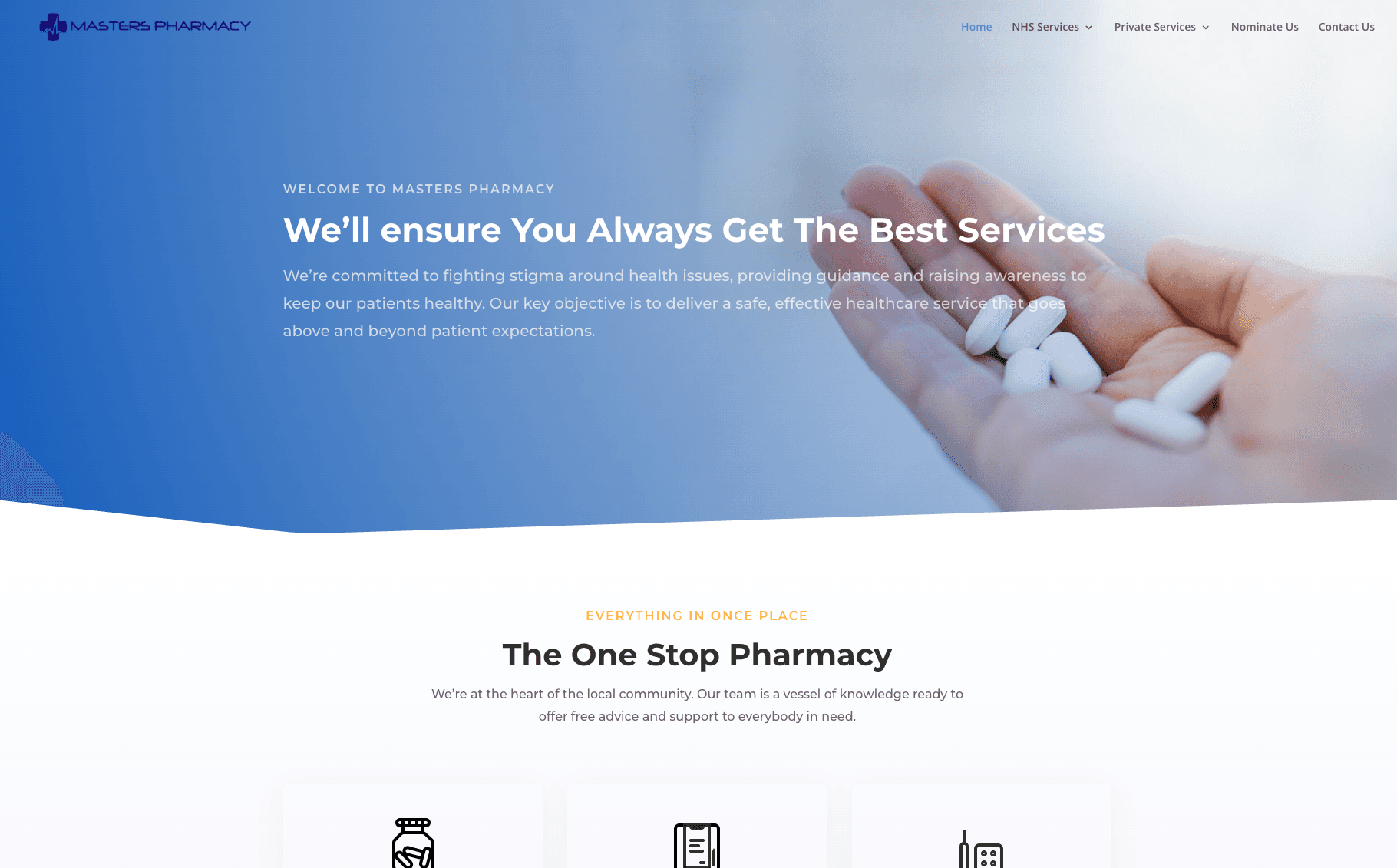
Case study 2: Masters Pharmacy
Project reference: Masters Pharmacy
Challenge
Masters Pharmacy needed a clearer digital journey for NHS services, repeat prescription requests, and private service education, while maintaining an accessible and community-oriented experience.
Solution
We implemented a modern website stack and page strategy with:
- Repeat prescription flow support.
- Service pages for Pharmacy First, flu services, and travel clinic content.
- Improved contact and opening-hours visibility.
- Performance and accessibility-first interface decisions.
- Content architecture designed for both patient usability and search discoverability.
Outcome snapshot
Post-launch monitoring showed improved service-path engagement, better user progression into prescription and enquiry actions, and stronger local-search alignment for high-intent service terms.
What this site does right
- Service-led navigation architecture.
- Better mobile readability and action paths.
- Clear contact and timing information.
- Sustainable foundation for ongoing SEO growth.
Common strengths across both projects
The strongest-performing pharmacy websites share consistent traits:
- Clear service positioning above the fold.
- Dedicated pages for high-intent services.
- Mobile-optimized booking/refill actions.
- Structured data support for better search interpretation.
- Performance-focused builds targeting fast load times.
If you want to see similar patterns in your own pharmacy growth plan, start with Website for Pharmacy service.
Pharmacy website design costs UK (2026)
Cost is one of the most searched buyer questions, especially for independent pharmacies budgeting digital growth.
Below are realistic pharmacy website cost UK ranges:
| Build type | Typical investment (ex VAT) | Best for |
|---|---|---|
| Template build (DIY or low-cost agency) | £1,000 - £3,000 | Very early-stage presence with limited growth ambitions |
| Semi-custom build (5-7 pages, basic SEO) | £4,000 - £7,000 | Single-location pharmacies wanting improved credibility |
| Full custom build (booking integration, local SEO, CRO) | £8,000 - £15,000 | Growth-focused independents prioritizing private service demand |
Typical ongoing investment:
- £200 - £500/month for hosting, security, updates, and ongoing SEO/content optimization.
What is usually included in our pharmacy website package
- Next.js or headless WordPress build.
- 7-10 pages (home, services, about, contact, blog, policy pages).
- LocalBusiness and Service schema implementation.
- Booking form or operational integration support.
- Mobile performance optimization.
- Three months post-launch support.
Cheap builds can be useful for minimal presence, but they often underperform when you need private-service growth and measurable ROI.
Action plan: launching your pharmacy website
Use this practical rollout plan to move from idea to measurable outcomes.
Step 1: Audit your current website (or define new build scope)
Review:
- Service page clarity.
- Mobile performance.
- Booking/refill pathways.
- Local SEO visibility.
- Compliance and policy coverage.
Step 2: Book a strategy call
A focused discovery call helps define priorities, technical constraints, and expected outcomes before budget is committed.
Step 3: Receive a detailed proposal and timeline
Most full projects run 6-8 weeks for core scope, depending on integrations and content readiness.
Step 4: Gather essential content and assets
Prepare:
- Service details and eligibility notes.
- Team and pharmacy photography.
- GPhC-related trust information.
- Opening hours and holiday schedule.
- Existing review and testimonial assets.
Step 5: Run delivery in structured phases
Design -> development -> QA/testing -> launch with analytics validation.
Step 6: Execute first 6 months of SEO + content
Post-launch momentum matters. Publish supporting guides, optimize priority pages monthly, and track booking outcomes.
FAQ: pharmacy website design UK
How long does it take to build a pharmacy website?
Most pharmacy websites take 4 to 8 weeks depending on complexity, content readiness, and integration requirements. A simpler semi-custom build can launch faster, while a fully custom conversion-focused project with booking workflows and deeper SEO setup may take longer. The most common delays are missing content, unclear service specifications, and slow approval cycles. A structured milestone plan helps reduce timeline risk.
Do I need a booking system or just a contact form?
If private services are a growth priority, a booking pathway is usually the better option. Contact forms can work for low-intent enquiries, but they create friction for patients who want immediate confirmation. Even a lightweight booking process can significantly improve conversion for flu, travel, and consultation services. The right answer depends on your operational workflow, staffing model, and service mix.
Can I use my NHS.uk profile content on my website?
You can align information across platforms, but your website should still present clear, original service details and user-friendly pathways. Keep core business details consistent across NHS and Google profiles while tailoring website content for conversion and patient comprehension. Consistency supports trust and local SEO.
What is the difference between WordPress and Next.js for pharmacy sites?
WordPress can be efficient for content-heavy workflows and teams that need frequent self-editing with minimal developer involvement. Next.js is often chosen when performance, scalability, and technical SEO control are top priorities. Both can work for pharmacy websites when implemented properly. Platform choice should be based on long-term business goals, internal capability, and growth requirements.
How do I rank on Google Maps for my pharmacy?
Google Maps visibility depends on profile quality, review signals, local relevance, and website alignment. Start by optimizing your Google Business Profile categories, services, opening times, and photos. Keep NAP details consistent across all directories and your website. Build location-relevant service pages and connect them with strong internal links. Add LocalBusiness schema and continuously gather genuine patient reviews. This combination improves local prominence over time.
Final next step
If you are planning a new pharmacy website design UK project, start with the two priority service routes:
Then review practical implementation guidance in SEO for Pharmacy guide, and explore real project references in Garner Chemist case study and Masters Pharmacy case study.
When you are ready, book a strategy session and we can map your build scope, timeline, and first six-month growth plan.
Pharmacy Website Design
Mobile-first pharmacy websites designed to turn local searches into booked appointments.
About the Author

Pankaj Karad
Founder & CEO
Pankaj Karad is the founder of Karad Infotech, a London-based agency specialising in web design, SEO, and software development for healthcare businesses across the UK.
Connect on LinkedIn
Pankaj Karad
Founder & CEO
Pankaj Karad is the founder and CEO of Karad Infotech, a London-based digital agency specialising in web design, software development, and SEO for healthcare businesses. With extensive experience in pharmacy and dental clinic digital solutions, Pankaj leads the strategy and delivery of projects that help UK healthcare providers grow their online presence and patient bookings.
Visit website