

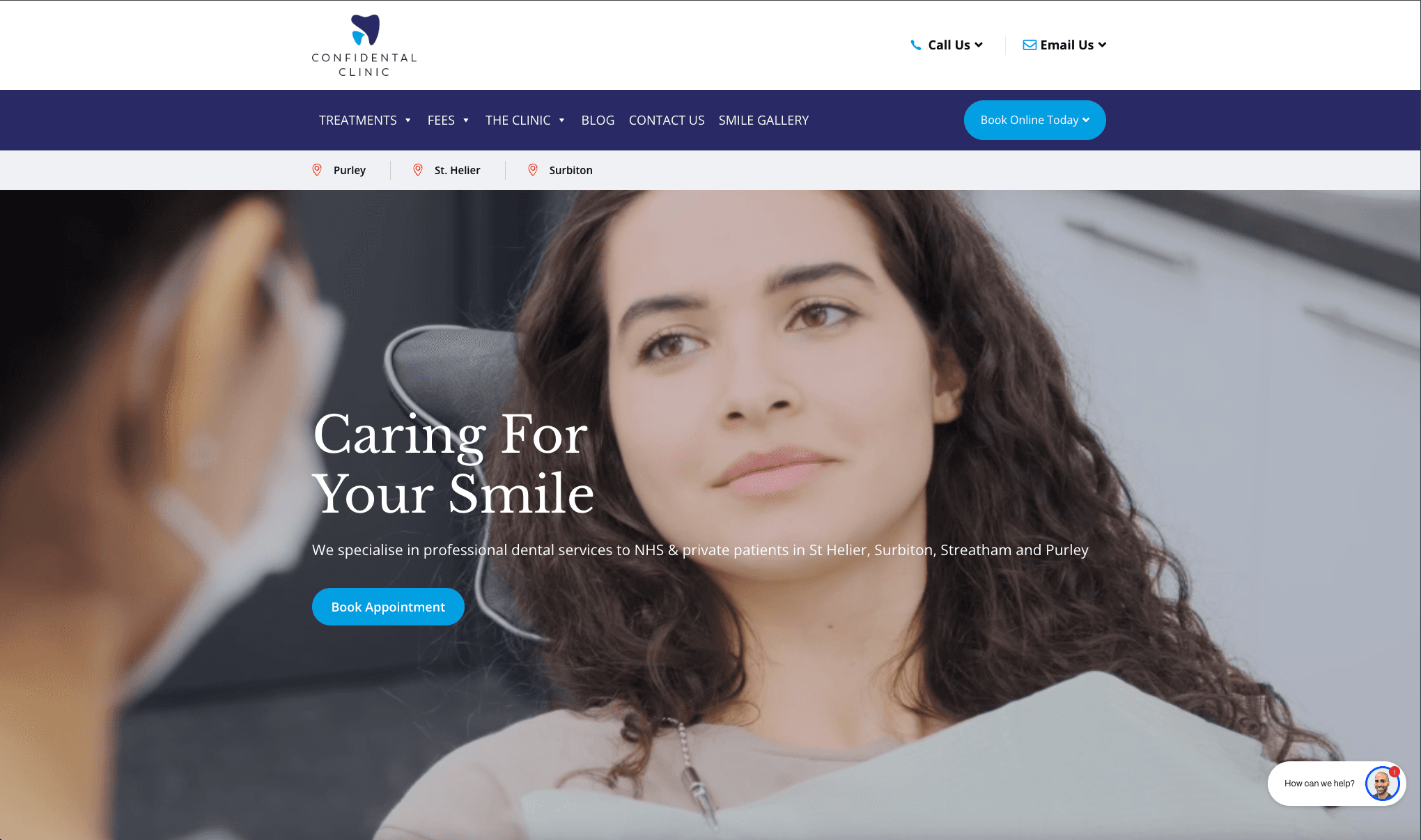
Most practices ask one question first: how much does a dental website cost in the UK in 2026? The honest answer is that the price depends on how many treatment pages you need, whether you want online booking and finance integrated, and how many locations you run. This guide gives you the real ranges, what moves the price up or down, the costs practices forget to budget for, and how to judge whether the spend is worth it.
Quick Answer
In 2026 a professionally designed dental website in the UK costs £5,000 to £12,000 for a single practice with core treatment pages and a booking flow, £12,000 to £25,000 for a practice or small group with a full treatment page set, finance integration, and online booking, and £25,000 to £60,000 or more for dental groups needing patient portals, centralised booking, or practice management integrations. Template builders cost £500 to £3,000 but rarely rank for treatment searches or meet GDC and CQC display requirements without extra work. Budget a further £300 to £600 a month for hosting, security, and updates.
Dental website design cost ranges in 2026
| Tier | Typical cost | Timeline | Best for |
|---|---|---|---|
| Template builder (Wix, Squarespace, dental template) | £500 – £3,000 | 1 – 3 weeks | Brand-new practices needing a placeholder site quickly |
| Practice Essentials | £5,000 – £12,000 | 5 – 8 weeks | Single practice, 10–18 pages, core treatment pages, booking-request flow |
| Practice Growth | £12,000 – £25,000 | 8 – 12 weeks | Practices growing private treatments, full treatment page set, finance, online booking, PMS integration |
| Dental Group | £25,000 – £60,000+ | 12 – 20 weeks | Multi-site groups, patient portals, referral systems, custom integrations |
These are the ranges we quote on our dental website design service, and they are in line with what specialist dental agencies across the UK charge. Generalist agencies often quote less because they leave out the treatment page depth, compliance work, and integrations that make a dental website earn its keep.
What drives the cost up or down
- Number of treatment pages. A page per treatment is the single biggest factor in both cost and results. Ten well-written, clinically reviewed pages cost more than one "Treatments" list, and they are the pages that rank.
- Online booking and practice management integration. Embedding Dentally, SOE EXACT, or R4 booking, or building a booking-request flow that lands in your PMS, adds development and testing time.
- Finance and membership plans. Finance calculators for Tabeo, Chrysalis, or Medenta, with the FCA-required representative example wording, and membership plan sign-up flows.
- Number of locations. Each practice needs its own page, map, hours, team, and reviews to rank in its own town.
- Compliance scope. GDC registration display, CQC rating widget, consent-compliant before-and-after galleries, UK GDPR privacy notice, cookie consent that blocks scripts, and WCAG 2.2 AA accessibility. Skipping these lowers the quote and raises your risk.
- Content and photography. Whether you supply copy and images or need the agency to write, review, and shoot them.
- Performance targets. Hitting Core Web Vitals on a mid-range phone takes image, font, and script work that templates skip.
Example scopes at each price point
Practice Essentials (£5,000 – £12,000)
- 10–18 pages: home, treatment pages for your top six to eight services, team with GDC numbers, fees, new patients, contact, and booking.
- Booking-request flow or embedded online booking, click-to-call on mobile.
- Dentist and MedicalClinic schema, Google Business Profile setup, local SEO for one town.
- GDC and CQC display requirements, privacy notice, cookie consent, accessibility baseline.
Practice Growth (£12,000 – £25,000)
- 20–40 pages with a dedicated page for every treatment, including implants, Invisalign, veneers, whitening, hygiene, emergency, and children's dentistry.
- Online booking integrated with your practice management system, finance calculators, and membership plan sign-up.
- Clinician profiles, review integration, consent-compliant galleries.
- Call tracking, GA4 with consent mode, and monthly conversion reporting.
- Location pages for two to five sites.
Dental Group (£25,000 – £60,000+)
- Multi-site architecture with a clinician directory across practices and centralised booking.
- Patient portal, referral workflow for referring dentists, or custom PMS and CRM integrations.
- Group-wide SEO and content system, bespoke reporting dashboards.
- Phased rollout with CRO sprints after launch.
Hidden costs to plan for
- Photography and content. Real practice and team photography converts far better than stock. Budget £800 to £2,000 for a half-day shoot and allow clinician time for copy review.
- Hosting, security, and updates. £300 to £600 a month for managed hosting, backups, security patching, CQC widget monitoring, and small content changes. A dental website that is not maintained loses rankings and breaks compliance features over time.
- Analytics and call tracking. GA4 setup is usually included; call tracking services cost £30 to £100 a month.
- Booking and finance platform fees. Online booking tools and finance providers charge their own subscription or per-transaction fees on top of the build.
- Redesign migration. If you are replacing an existing site, redirect mapping and content migration add one to two weeks. Our healthcare website redesign guide covers how to protect your rankings through the move.
Timelines and checkpoints
- Weeks 1–2: discovery, treatment audit, site structure, wireframes, content outline.
- Weeks 3–5: visual design, treatment page copy and clinical review, schema and performance budget.
- Weeks 5–8: build, integrations, content load, accessibility and compliance QA, launch plan.
- Growth and Group projects add integration testing and phased rollouts, taking the timeline to 8–20 weeks.
Is a dental website worth the cost? Tie the spend to bookings
Work backwards from treatment value. If an implant patient is worth £2,500 to £4,000 and an Invisalign patient £3,000 to £4,500, a website that produces three to five extra high-value bookings a month adds £100,000 to £200,000 a year in treatment revenue. Against a £12,000 to £20,000 build and £5,000 a year in running costs, payback usually lands within the first six months.
The practices that do not see that return are the ones that bought a template, hid their prices, or launched without a page for each treatment. Our dental practice website design guide covers the conversion elements that make the difference, and our healthcare website ROI calculator lets you model your own numbers.
Next step
Want a scoped estimate for your practice? Book a consultation and we will map scope, integrations, and a launch timeline in 30 minutes, and send a fixed-price proposal within five working days.
Dental Website Design UK
Treatment-led dental websites for UK practices and groups, GDC and CQC compliant, built to rank for treatment searches and convert into booked appointments.
About the Author

Pankaj Karad
Founder & CEO
Pankaj Karad is the founder of Karad Infotech, a London-based agency specialising in web design, SEO, and software development for healthcare businesses across the UK.
Connect on LinkedInFAQ: dental website design cost
How much does a dental website cost in the UK?
A professionally designed dental website costs £5,000 to £12,000 for a single practice, £12,000 to £25,000 for a practice growing private treatments with online booking and finance integration, and £25,000 to £60,000 or more for dental groups with portals or custom integrations. Template builders cost £500 to £3,000 but rarely rank or meet dental compliance requirements without further work.
Why do dental website quotes vary so much?
Quotes vary because agencies include different things. A low quote usually means one services page instead of a page per treatment, no booking or finance integration, no compliance work, and stock photography. A specialist dental quote includes clinically reviewed treatment pages, GDC and CQC display requirements, PMS integration, and local SEO, which is what produces bookings.
What is the cheapest way to get a dental website?
A template builder such as Wix or Squarespace with a dental theme costs under £3,000 and can be live in weeks. It is a reasonable placeholder for a brand-new practice, but expect to replace it within one to two years once you need treatment pages that rank, online booking, and proper compliance.
How much should I budget for running a dental website each year?
Allow £3,600 to £7,200 a year for managed hosting, security, backups, updates, and monitoring, plus any booking platform, finance provider, or call tracking subscriptions. Practices investing in growth typically add £1,000 to £3,000 a month for dental SEO.
How long does a dental website take to pay for itself?
For most private practices, a well-built site pays back within six months. Three to five extra implant or Invisalign bookings a month, at £2,500 to £4,500 each, covers a £12,000 to £20,000 build many times over in the first year.

Pankaj Karad
Founder & CEO
Pankaj Karad is the founder and CEO of Karad Infotech, a London-based digital agency specialising in web design, software development, and SEO for healthcare businesses. With extensive experience in pharmacy and dental clinic digital solutions, Pankaj leads the strategy and delivery of projects that help UK healthcare providers grow their online presence and patient bookings.
Visit website